A guide to...
Using electric storage heaters
How do they work?
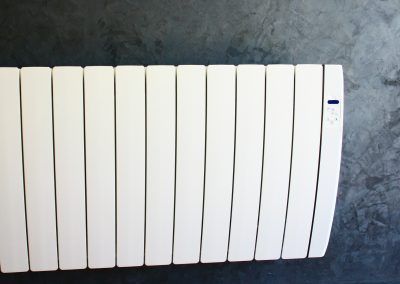
Night storage heaters are designed to store heat from electricity supplied at a cheaper night time tariff and then release it during the following day.
The ‘core’ of the heater is made up of electrical elements embedded in clay or ceramic brick. When switched on (usually at night) these elements heat up and transfer this heat to the brick where it is stored and gradually released the following day.
Controls
Your storage heaters will usually have two controls: one that controls the amount of electrical energy going in overnight (the input) and one that controls the amount of warm air coming out the following day (the output).
The ‘Input’ Dial (sometimes called ‘overnight charge’)
This sets how much heat is produced and stored during the night. Your input will either be manual or automatic…
Manual Input
You can vary the setting to store more heat when the weather is colder. It is generally recommended that you follow seasonal changes rather than trying to reset them on a daily basis. We would recommend setting it to high in the winter and medium in the autumn and spring (with the heating turned off over the summer).
Automatic Input (sometimes called ‘Auto-Set’)
Automatic or ‘Auto-Set’ means that the input is controlled by a thermostat. In this case you do not need to change the setting when the weather changes. It will automatically produce more heat when the weather is colder. Try out different settings to find out which gives the most comfortable temperature the following day and evening. Once you have decided on the right setting, this can be left as it is.
Some storage heaters (such as those manufactured by ‘Berry’) have a switch that allows you to switch between Manual or Automatic Input control. It is better to keep it on Automatic so that the input is adjusted automatically for you.
Please note: If you have ‘top up’ heat from a gas or electric fire late into the night it could affect the automatic thermostat. It will make the thermostat think the weather is warmer than it actually is and the storage heater may not store up enough heat overnight.
The ‘Output’ dial (sometimes labelled ‘room temperature’ or ‘boost control’)
This controls the amount of heat given out by the heater.
It does this by opening and closing a flap on the heater, controlling the amount of warm air that is released.
It is most economical to set the output control to minimum during the night, when the household is sleeping, and only turn it up when you need it. That way you will keep as much heat as possible for use later when you may need it the most.
If you find that you are still running out of heat by the evening, try turning the input control higher to produce more heat for the next day.
Please note: Depending on your needs and circumstances (i.e. when you are at home during the day and how much warmth you require), your ideal settings may vary from those outlined above. You can always call our Freephone advice line on 0800 500 30 76 and they will be able to give you more detailed advice tailored to your individual circumstances. Additional controls
Economy 7 tariffs
If electric night storage heaters are the main means of heating your home, you should be on an Economy 7 tariff. This means that you benefit from a cheaper tariff for any electricity used during the night.
The hours of cheap electricity are normally from 12 midnight until 07:00 in winter, and from 01:00 to 08:00 in summer. However, this can vary so it’s best to check with your supplier if you’re not sure.
Some suppliers also have economy 10 tariffs where you benefit from cheaper electricity during 7 night-time hours and 3 daytime hours.
It is important to use the cheap rate to a) heat up your storage heaters and b) heat up your hot water with your immersion heater.
It also means that doing late night / early morning washing, tumble drying etc could save you money. However, it is not recommended to have appliances such as tumble driers on when you are asleep due to the risk of fire.
Reading your Economy 7 Meter
‘Standard’ Economy 7 Meter
On a standard Economy 7 meter the top reading (marked Day, High or 1) usually records all units used during the day and the lower reading (marked Night, Low or 2) usually record all units used during the cheaper night-time period.
Pre-payment Economy 7 Meter
By pushing the display button several times these meters will display various readings (e.g. date, time, rate 1, Rate 2 etc).
Rate 1 usually shows units used during the day and rate 2 usually shows units used during the cheaper night-time period. However, this can vary so it is best to check the manual or ask your energy supplier if you’re not sure.
Electric water heating
If you heat your water using Economy 7 electricity, you will have a hot water storage cylinder fitted with an immersion heater. This is an electrical element which works like the element in a kettle to heat up the water in the cylinder. It is best to heat the water up at night using the cheaper night time electricity ready for use the following day. Therefore, it is very important that the controller is showing the correct time, otherwise it may heat up during the day, using expensive daytime electricity.
You may have two immersion heaters in the same cylinder: in this case the lower one is to heat up a whole tank of water, and should be on at night, while the upper one heats only half a tank and will come on when you use ‘boost’. This should only be used when you have run out of hot water as, when you use the boost during the day, you are using expensive day-rate electricity.
Thermostat
A thermostat in the immersion heater prevents the water from overheating. It will switch off the immersion heater when the set temperature is reached. This should be set to 60°C which is hot enough to kill any bacteria whilst avoiding using more electricity than necessary.
More advice
Our advisers are on hand to answer any questions you may have, and may also be able to offer you a free home visit to provide in-depth advice specific to your property and needs. Give us a call on 0800 500 3076 for more information.